Freedom and Connection: On Fannie Lou Hamer and The Handmaid’s Tale

Fannie Lou Hamer wanted us to see the ways in which we are connected and the degree to which the freedom of one of us is related to the freedom of all of us.

This issue of connectedness plays out in various aspects of The Handmaid’s Tale.  For example, Nick, who starts as a “Guardian” of Gilead and is later promoted to “Commander,” seems to never really buy the propaganda the regime is selling.  He seems uncomfortable in the roles he has been assigned, but is not free to choose another path.  Those seen as traitors of Gilead are quickly executed and hung on the wall.  Nick does not want that for himself.  So he goes along with the program – undermining the system in small ways – but ultimately, playing his role and living the life assigned to him, rather than the life he would prefer with June, the woman he loves, and their daughter.  Nick is not free.

In fact, none of the people of Gilead are free – not even the commanders and their wives.  The costs of failing to go along with the system are high, even for those at the top of the hierarchy.  Serena lost a finger when she stepped outside the place assigned to her, and her husband Fred, knows if he is returned from Canada to Gilead, he will be judged a traitor and quickly executed.  Fred and Serena are not free.

The show offers many examples of ways in which characters recognize and fail to see connections they have to each other based on status.  The wives share a connection with each other, as do handmaids, Marthas and aunts.  The strengths and weaknesses of these connections determine the access to freedom citizens of Gilead possess.

From her locked place in society, Fannie Lou Hamer saw these kinds of connections among Americans and Black people throughout the diaspora.  She urged us all to recognize these links and empower ourselves to grasp the freedom that should be the birthright of every living being.

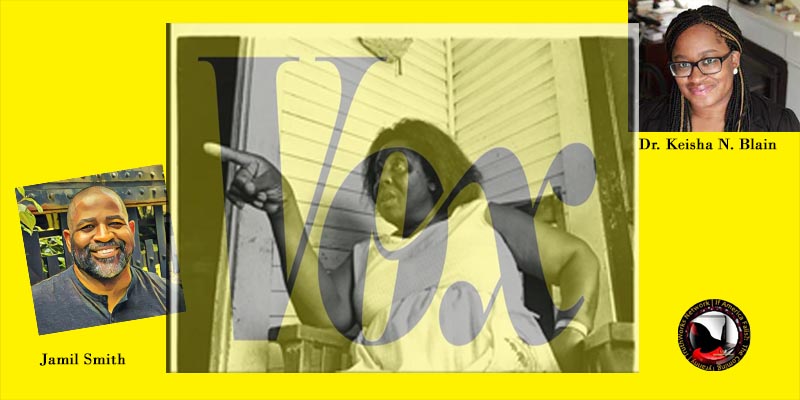
Below are a few highlights of the Vox discussion on Hamer between Jamil Smith and Keisha Blain.  — LMO

JS:  “The human rights activist and former sharecropper once said that ‘you are not free whether you are white or black, until I am free.’ Historian Keisha Blain discusses how Hamer’s message resonates today.”

JS:  “We hear the term ‘freedom’ bandied about rather loosely in this country. It’s one of those things people say they love, but are we really free? In many instances, ‘freedom’ feels more like America’s consumer brand than one of its core principles — mostly because we see those principles violated with regularity…The late Fannie Lou Hamer understood this all too well…

JS:  “…Hamer gave what became a landmark speech at the 1964 Democratic National Convention…This speech was one of the many reasons I wanted to talk with Hamer’s most recent biographer, Keisha Blain, PhD. A historian at the University of Pittsburgh, Blain is the author of Until I Am Free: Fannie Lou Hamer’s Enduring Message to America.  In the book — which is partly a contemporary social commentary — Blain describes how Hamer was accustomed to seeing rights and freedoms technically guaranteed to her as an American discarded because she was a Black woman…Hamer urged those listening to understand that denying her rights was, in fact, a refutation of American ideals…

‘We have a long fight and this fight is not mine alone. But you are not free, whether you are white or black, until I am free.’

Fannie Lou Hamer

JS:  “That brings me to that quote that seems to have inspired your book title, which is, of course, ‘We have a long fight and this fight is not mine alone. But you are not free, whether you are white or black, until I am free.’ And that not just encapsulates the universality of justice and accountability here in the States but abroad…

KB:  “What Hamer did, and why it’s so powerful, even in the current moment to reflect on, is she said, ‘Listen. It’s not just about you. We have to think in the collective way. We’re all members of the American polity.’ That means that if someone is hurting, it does affect you. If someone is in chains, you are not free, even if you think you are. Right?…

KB:  “We may come from different backgrounds, you know, different socioeconomic status, or different races, ethnicities, and so on, but because we are all in this nation, we are connected. And the future of the nation depends on all of us. And she would emphasize that regardless of who you were you have to be concerned about the person next to you… not everyone will immediately embrace that notion, but she constantly tried to get people to see that they needed to be concerned about the next person. Because if the next person experiences liberation, you too can benefit. And if another person is in chains, you can’t truly enjoy freedom…”

SUBSCRIBE to the “If America Fails?” Events Calendar

How do you find the LIVE webcasts of “If America Fails?:  The Coming Tyranny,” you may be asking yourself.  It’s easy!  SUBSCRIBE to the “If America Fails?” Events Calendar and NEVER miss an episode!

We broadcast live on Thursdays at 8 pm ET.  See you soon!


In Defense of Black Migrants: Haitians at Del Rio

America’s racism, deep and entrenched as it is, is whittling away at the limited freedoms and benefits we are taught to associate with this country.  America is indeed exceptional – exceptionally steeped in an ideology of white supremacy that leads to acts of extreme cruelty, insanity and crimes against humanity.

The fact that so many people continue to want to come here is both a measure of the idealistic way in which they have learned to see this country, and the harshness of the conditions they seek to escape.

Black Americans have argued for decades, to deaf ears, that what we allow to be done to Black people will eventually become acceptable for all people.  America has not learned this lesson yet, and we see the results in our dwindling democracy and approaching tyranny.  Is it too late to learn?

Consider the ways in which civil rights groups continue to grapple with pulling the country back from a point of no return.   — LMO

“The treatment of Haitians apprehended in Del Rio, Texas, has galvanized civil rights groups and others to press for change…

“The Border Patrol’s actions in Del Rio were raised repeatedly on Tuesday during the Senate confirmation hearing for Mr. Biden’s choice to lead Customs and Border Protection, Chris Magnus…

“But what happened in Del Rio is not just about the horses, immigration and civil rights advocates said. It is about the poor treatment of Black migrants that has spanned administrations, often overshadowed by the larger debate about the broken immigration system and a persistent focus on waves of migrants from Central America…

“Recent reports have found that Black migrants are more often placed in solitary confinement in immigration detention, face a higher rate of deportation than any other race and see higher bonds set by immigration judges…

“Recent reports have found that Black migrants are more often placed in solitary confinement in immigration detention, face a higher rate of deportation than any other race and see higher bonds set by immigration judges…”

“’The connections have been made for Black people,’ said Judith Browne Dianis, the executive director of the Advancement Project, a civil rights organization. ‘And accountability requires that the Biden administration act, because all Black people saw it, and we can’t unsee it…’

“But there is little indication that the policies used to turn Haitian and other migrants away in September will change, particularly as the administration fights in court to keep the Trump-era public health rule in place…

“’Is the Biden administration ready to do something different when the next wave of Black migrants wind up at the border?’ said Ms. Dianis, of the Advancement Project. ‘I am not confident that they have a different plan than the one that they used this time.’”  — Eileen Sullivan | The New York Times

“How Far Down the Road Towards Fascism Has America Gone?” by Thom Hartmann

“We are close to either a collapse or a renewal of democracy: which way will America go?”

“We are close to either a collapse or a renewal of democracy: which way will America go?”

“While there’s apparently ‘nothing to see here’ when it comes to conservative media outlets and even, in many ways, mainstream media, it’s worth asking the question: ‘How far down the road toward authoritarian oligarchy, or even outright fascism, have we gone?’… We are close to either a collapse or a renewal, and increasingly the bets are going for collapse as two Democratic senators preserve the filibuster and, through it, the Republican Party’s control over our electoral and legislative processes…even though Republicans in the Senate represent 41 million fewer Americans than do the Democrats who are theoretically in power…

“As Tom Hayden reminded an earlier generation, if ever there was a time for us to jump into political involvement with everything we have, this is it.  The rightwing billionaires and their shills are already all-in:  now it’s up to genuinely patriotic Americans to save this nation from the traitors within.”  — Thom Hartmann

Bystanders Ignore Woman Being Raped: On Finding Courage

Watching a policeman squash a man to death with his knee to the neck of George Floyd feels qualitatively different than sitting in a train car and ignoring a woman being raped by a homeless man.  Is it?  I don’t know.  We are often challenged to make moral and ethical choices on the question of when and whether to act to save a human life or prevent the commission of a crime.  I know these choices aren’t easy, but I also know some are easier than others.

It seems like dialing 911 or physically intervening in an active rape would be an easy thing to do, a natural thing to do, and something we should be able to expect from our fellow human beings.  So it bothers me and I wonder how it is that multiple people aboard this train car, failed to intervene in an active case of rape.  What kind of humans were these?  What has happened to people that we could evidence such callous disregard?  What if that had been your mother, or sister or girlfriend – would you have an expectation that someone on the train car would have sought a way to help?

In The Handmaid’s Tale, people watch or are forced to participate in all manner of violence and abuse.  It’s horrifying to watch, but also easy to see the fear and survival instinct at play.  I think if we want to avoid the world described in this fact-based, fictional story, we must practice small acts of courage and resistance.  We must become intolerant of violence and injustice.

Deciding how to react to witnessing a police officer killing a human being is, arguably, a difficult ethical challenge.  We are taught to respect authority and that police exist to protect good citizens.  We probably don’t know why an officer has stopped someone or what crime he may be addressing.

Intervening in a rape on an enclosed train car should not be a difficult choice.  Shame on the bystanders who let this happen.  — LMO

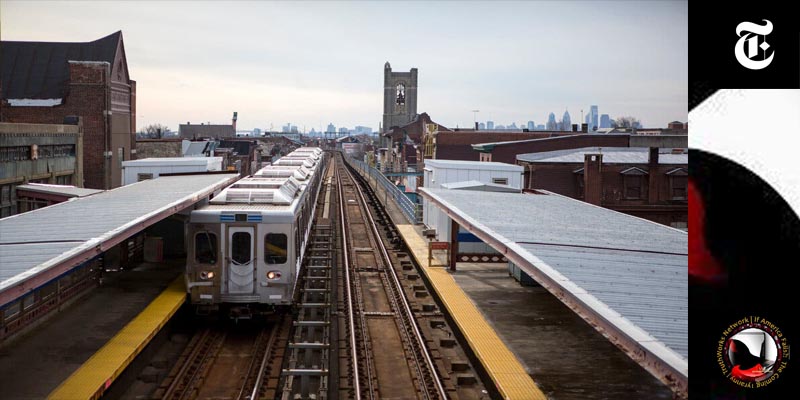
“The SEPTA train car near Philadelphia had several passengers aboard but none called 911 while the woman was sexually assaulted, the authorities said…

“A man whom officials identified as Fiston Ngoy sat down next to a woman at about 10 p.m. on a train that was traveling westbound on the Market-Frankford Line toward the 69th Street Transportation Center. Mr. Ngoy ‘attempted to touch her a few times,’ said Andrew Busch, a spokesman for the Southeastern Pennsylvania Transportation Authority, known as SEPTA.

“The woman pushed back and tried to stop Mr. Ngoy from touching her, Mr. Busch said. ‘Then, unfortunately, he proceeded to rip her clothes off,’ Mr. Busch said on Sunday…

“Bystanders on the train who failed to intervene could be criminally charged if they recorded the attack, Mr. Bernhardt said, adding that it would be up to the Delaware County district attorney’s office to make such a decision after the police finish their investigation and submit their findings…”  — Eduardo Medina | The New York Times

A “Shadow Presidency” in a Chaotic World

@ASoulAFire @JaniceOCG @Utrice_Leid continues her inquiry into the curious response of Americans to the presence of the ex-president on the political landscape.  She perceives chaos around the world getting worse and wonders if it is a result of humanity being too timid to defend ourselves.  Leid includes examples of the chaos, such as Trump running what she sees as a “shadow presidency,” and the recent revelation that more than 200,000 children were sexually abused by French clergy of the Catholic Church, over the past 70 years.  As always, she pushes us to consider what is going on in the world and to examine our reactions to it.  — LMO

Accelerating the End of Capitalism and Radical Social Change

Accelerationism – In political and social theory, accelerationism is the idea that capitalism, or some processes associated with it, and technological change should be (or is) “accelerated” and drastically intensified to create radical social change. Sometimes, and often in a pejorative sense, it may refer to the theory that the end of capitalism should be brought about by its acceleration.

For more background on this murderous idea, see linked article.  Highlights are below.  — LMO

“Bernstein’s 2018 slaying marked the beginning of an extraordinary period of white supremacist violence — a spate of murders and mass shootings that has continued through this year. The October 2018 shooting at Pittsburgh’s Tree of Life synagogue was the deadliest act of anti-Semitic violence in American history. The March 2019 Islamophobic attack on mosques in Christchurch, New Zealand, was the deadliest mass shooting in the country’s history. It was followed in April by another attack on an American synagogue (this time in Poway, California), and an August 2019 shooting at an El Paso  Walmart that was one of the most brutal attacks targeting Hispanics in US history…

“These killings were often linked to the alt-right, described as an outgrowth of the movement’s rise in the Trump era. But many of these suspected killers, from Atomwaffen thugs to the New Zealand mosque shooter to the Poway synagogue attacker, are more tightly connected to a newer and more radical white supremacist ideology, one that dismisses the alt-right as cowards unwilling to take matters into their own hands.

“It’s called ‘accelerationism,’ and it rests on the idea that Western governments are irreparably corrupt. As a result, the best thing white supremacists can do is accelerate their demise by sowing chaos and creating political tension. Accelerationist ideas have been cited in mass shooters’ manifestos — explicitly, in the case of the New Zealand killer — and are frequently referenced in white supremacist web forums and chat rooms.

“It’s called ‘accelerationism,’ and it rests on the idea that Western governments are irreparably corrupt. As a result, the best thing white supremacists can do is accelerate their demise by sowing chaos and creating political tension.”

“Accelerationists reject any effort to seize political power through the ballot box, dismissing the alt-right’s attempts to engage in mass politics as pointless. If one votes, one should vote for the most extreme candidate, left or right, to intensify points of political and social conflict within Western societies. Their preferred tactic for heightening these contradictions, however, is not voting, but violence — attacking racial minorities and Jews as a way of bringing us closer to a race war, and using firearms to spark divisive fights over gun control. The ultimate goal is to collapse the government itself; they hope for a white-dominated future after that…

“Though violence is celebrated as the preeminent tactic, they’re willing to endorse non-violent means as well. Accelerationists have proposed distributing flyers for racist rallies alongside ones for a counter-rally, to stoke social division and create conflict. They suggest you should always vote for the most radical candidate in any election, regardless of their position on the political spectrum, to undermine the system’s coherence. One poster I saw even heralded the rise of Bernie Sanders, a Jewish socialist, on the grounds that his proposed expansions of the welfare state would bankrupt the US government and thus undermine its grip on power.

“They suggest you should always vote for the most radical candidate in any election, regardless of their position on the political spectrum, to undermine the system’s coherence.”

“In their view, any sort of increase in social tension is good as long as it accelerates us toward system collapse — and individuals have an obligation to do what they can to hasten us along this path. Even, or more precisely, especially committing murder…

“’As late as Dylann Roof [the 2015 Charleston, South Carolina, church shooter], the reaction of white supremacists was kind of ambivalent,’ says Mark Pitcavage, a senior research fellow at the Anti-Defamation League. ‘Now … they want more people like that to emerge.’”  — Zack Beauchamp | The Highlight by Vox

“In their view, any sort of increase in social tension is good as long as it accelerates us toward system collapse — and individuals have an obligation to do what they can to hasten us along this path. Even, or more precisely, especially committing murder…”

Philly Residents Shut Down White Nationalist Group March By Simply Scaring Them Off

Remember when Black folk in Philly chased a white supremacist group out of Philly last summer?  LOL 🙂

For all the drama, trauma, heartache, chaos and pain these groups seek to inflict on the world, clearly they are not all as tough as they pretend to be.  Of course, facing an angry group of Black folks does take a great deal of courage!

Courage.  Black people have so much to teach white America – including lessons on resistance – lessons on courage – lessons that are needed on the descent to tyranny.  Yet the student must be willing and able to learn. Oh well…hopefully the so-called “Patriot Front” who attempted to frighten and intimidate Philadelphians learned a lesson of respect for humans they consider to be different from themselves.  #PassTheWord  — LMO

“Putting on a tough front can be beneficial to one’s ego, but there’s always that slim chance you’ll get brought back to Earth with a simple G-check.

“That ended up being the case recently for Patriot Front, a white nationalist group that figured it would be a good idea to orchestrate a march through Penn’s Landing only to quickly find out that Philly don’t play when it comes to right-wing bigotry… “They started engaging with citizens of Philadelphia, who were none too happy about what they were saying. These males felt threatened, and, at one point, somebody in their crowd threw a type of smoke bomb to cover their retreat, and they literally ran away from the people of Philadelphia, said Philadelphia Police Officer Michael Crum.”  — Keenan “HIGz” Higgins | BlackAmericaWeb.com

“How Fascism Works: The Politics of Us and Them” by Jason Stanley

I don’t know how many people alive today have witnessed the onset of fascism – but for those of us who have not seen it, it can certainly be very unsettling.  It helps to recognize the signs and to begin thinking through ways in which we might respond to certain tactics, actions and events.  Jason Stanley’s How Fascism Works:  The Politics of Us and Them, is just such a guide.  Take comfort.  — LMO

“With unsettling insight and disturbing clarity, How Fascism Works is an essential guidebook to our current national dilemma of democracy vs. authoritarianism.” — William Jelani Cobb, author of The Substance of Hope

“With unsettling insight and disturbing clarity, How Fascism Works is an essential guidebook to our current national dilemma of democracy vs. authoritarianism.” — William Jelani Cobb, author of The Substance of Hope

“A vital read . . . The book provides a fascinating breakdown of the fascist ideology, nimbly interweaving examples from Germany, Italy and Hungary, from Rwanda and Myanmar to Serbia and, yes, the US. As he proceeds through his framework of the broadest features of his subject, Stanley includes smaller observations that may for some readers land bracingly close to home.”—The Guardian

“No single book is as relevant to the present moment.” — Claudia Rankine, author of Citizen

“NEW YORK TIMES BOOK REVIEW EDITORS’ CHOICE • With a new preface • Fascist politics are running rampant in America today—and spreading around the world. A Yale philosopher identifies the ten pillars of fascist politics, and charts their horrifying rise and deep history.”

“He knits together reflections on history, philosophy, sociology, and critical race theory with stories from contemporary Hungary, Poland, India, Myanmar, and the United States, among other nations. He makes clear the immense danger of underestimating the cumulative power of these tactics, which include exploiting a mythic version of a nation’s past; propaganda that twists the language of democratic ideals against themselves; anti-intellectualism directed against universities and experts; law and order politics predicated on the assumption that members of minority groups are criminals; and fierce attacks on labor groups and welfare.”

“As the child of refugees of World War II Europe and a renowned philosopher and scholar of propaganda, Jason Stanley has a deep understanding of how democratic societies can be vulnerable to fascism: Nations don’t have to be fascist to suffer from fascist politics. In fact, fascism’s roots have been present in the United States for more than a century. Alarmed by the pervasive rise of fascist tactics both at home and around the globe, Stanley focuses here on the structures that unite them, laying out and analyzing the ten pillars of fascist politics—the language and beliefs that separate people into an ‘us’ and a ‘them.’ He knits together reflections on history, philosophy, sociology, and critical race theory with stories from contemporary Hungary, Poland, India, Myanmar, and the United States, among other nations. He makes clear the immense danger of underestimating the cumulative power of these tactics, which include exploiting a mythic version of a nation’s past; propaganda that twists the language of democratic ideals against themselves; anti-intellectualism directed against universities and experts; law and order politics predicated on the assumption that members of minority groups are criminals; and fierce attacks on labor groups and welfare. These mechanisms all build on one another, creating and reinforcing divisions and shaping a society vulnerable to the appeals of authoritarian leadership.

“Only by recognizing fascists politics, he argues, may we resist its most harmful effects and return to democratic ideals.”

“By uncovering disturbing patterns that are as prevalent today as ever, Stanley reveals that the stuff of politics—charged by rhetoric and myth—can quickly become policy and reality. Only by recognizing fascists politics, he argues, may we resist its most harmful effects and return to democratic ideals.”  — Publisher

Neo-Nazis Infiltrate German Military & Prep for Social Collapse

This is the second of two articles Dr. Karen A. Ritzenhoff shared with her honors students in a class on “Terror, Trauma and Identity” as they watched the films “BlacKkKlansman” by Spike Lee and “If Beale Street Could Talk,” based on James Baldwin’s novel, adapted by Barry Jenkins.  — LMO

Below are a few excerpts:

“Germany has woken up to a problem of far-right extremism in its elite special forces. But the threat of neo-Nazi infiltration of state institutions is much broader…

“The plan sounded frighteningly concrete. The group would round up political enemies and those defending migrants and refugees, put them on trucks and drive them to a secret location…Then they would kill them…”

“The plan sounded frighteningly concrete. The group would round up political enemies and those defending migrants and refugees, put them on trucks and drive them to a secret location…Then they would kill them…

“The group grew out of a nationwide chat network for soldiers and others with far-right sympathies set up by a member of Germany’s elite special forces, the KSK. Over time, under Mr. Gross’s supervision, they formed a parallel group of their own. Members included a doctor, an engineer, a decorator, a gym owner, even a local fisherman…”

“The group grew out of a nationwide chat network for soldiers and others with far-right sympathies set up by a member of Germany’s elite special forces, the KSK. Over time, under Mr. Gross’s supervision, they formed a parallel group of their own. Members included a doctor, an engineer, a decorator, a gym owner, even a local fisherman…

“Germany has belatedly begun dealing with far-right networks that officials now say are far more extensive than they ever understood. The reach of far-right extremists into its armed forces is particularly alarming in a country that has worked to cleanse itself of its Nazi past and the horrors of the Holocaust. In July the government disbanded an entire company infiltrated by extremists in the nation’s special forces…

“Neo-Nazi groups and other extremists call it Day X — a mythical moment when Germany’s social order collapses, requiring committed far-right extremists, in their telling, to save themselves and rescue the nation…”

“One central motivation of the extremists has seemed so far-fetched and fantastical that for a long time the authorities and investigators did not take it seriously, even as it gained broader currency in far-right circles…Neo-Nazi groups and other extremists call it Day X — a mythical moment when Germany’s social order collapses, requiring committed far-right extremists, in their telling, to save themselves and rescue the nation…

“Of some 30 Nordkreuz members, only two others, a lawyer and another police officer, are currently under investigation by the federal prosecutor on suspicion of plotting terrorism…The outcome is typical of the authorities’ handling of far-right cases, extremism experts say. The charges brought are often woefully narrow for the elaborate plots they are meant to deter and punish. Almost always they focus on individuals, not the networks themselves…

“Over two years, the raids and intelligence work uncovered weapons, ammunition, enemy lists, and a handwritten order list for Day X that included the body bags and quick lime.”  — Katrin Bennhold | The New York Times

“The outcome is typical of the authorities’ handling of far-right cases, extremism experts say. The charges brought are often woefully narrow for the elaborate plots they are meant to deter and punish. Almost always they focus on individuals, not the networks themselves…”