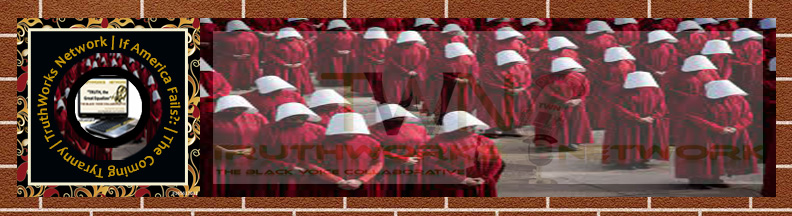
"If America Fails?: The Coming Tyranny" ::: Examining "The Handmaid’s Tale". . .the fictional story that explores the real potential of the U.S. as a failed state.
“How did the the United States become the Republic of Gilead in The Handmaid’s Tale? The never-ending belief in male dominance, women’s complicity in those beliefs, and people not wanting to be bothered with anything that did not immediately affect their lives—that’s how. Offred, the protagonist was guilty of the latter, just as many are guilty of that today.”
How Close Are We to Becoming a Gilead in The Handmaid’s Tale? Written By Kiesha Richardson
“If America Fails?: The Coming Tyranny” Examining The Handmaid’s Tale. . .the fictional story that explores the real potential of the U.S. as a failed state. Discussion of “The Handmaid’s Tale” ( Hulu series) through the lens and perspectives of the Black experience – the events, characters, and the capacity of the U.S. to fail – exploring the potential of what a failed state and fascism might mean for Black people.
When written, nothing included in the story had NOT happened in human history. The best-selling novel by Margaret Atwood is set in Gilead, a totalitarian society in what used to be part of the United States. Gilead is ruled by a fundamentalist regime that treats people, other than white men, as property of the state, takes place following some environmental disasters that cause a plummeting birth rate. The new regime forces the U.S. system of democracy into failure, and in the midst of chaos and civil war. The areas where the “Gilead Republic governs” in previous American regions, establishes strict caste and penal systems. The series will feature a weekly panel, followed by audience discussion and open chat. Let us know of your interest. L. Michelle Odom, Senior Producer. More information: TWN@truthworksnetwork.com @TruthWorks Radio Network
Are you a student of, political junkie fan, a serious viewer of Hulu’s production of “The Handsmaid’s Tale?” If so, TruthWorks Radio Network is in production of a Fall Discussion series, “If America Fails?: The Coming Tyranny.” Examining “The Handmaid’s Tale“. . .the fictional story that explores the real potential of the U.S. as a failed state. Would you be interested in joining us during our broadcasts leading up to Season 5? Seeking input through the lens and perspectives of the Black experience – the events, characters, and the capacity of the U.S. to fail – exploring the potential of what a failed state and fascism might mean for Black people. The series will feature a weekly panel, followed by audience discussion and open chat. Let us know of your interest. L. Michelle Odom , Senior Producer. Respond below.
“If America Fails?: The Coming Tyranny” (IAF) uses themes from The Handmaid’s Tale, the fictional story that explores the real potential of the U.S. as a failed state, to consider the chance of these events occurring in our modern society. We offer discussion of “The Handmaid’s Tale” ( Hulu series) through the lens and perspectives of the Black experience – considering the events, characters, and the capacity of the U.S. to fail – and what this could mean for Black people. IAF explores the potential of what a failed state and fascism might mean for Black people.
When written, nothing included in the story had NOT already happened in human history. The best-selling novel by Margaret Atwood is set in Gilead, a totalitarian society in what used to be part of the United States. Gilead is ruled by a fundamentalist regime that treats people, other than white men, as property of the state. It takes place following some environmental disasters that cause a plummeting birth rate. The new regime forces the U.S. system of democracy into failure, and plunges it into chaos and civil war. The areas where the “Gilead Republic governs,” in previous American regions, establishes strict caste and penal systems.
The If America Fails? series will feature a weekly panel of subject matter experts in the themes presented by the book and Hulu series, The Handmaid’s Tale, and will be followed by audience discussion and open chat. Some of the themes are fascism, religion and civil war – and of course, the status of women in a highly controlled, authoritarian theocracy. If you’re a fan of the book or TV series, or an expert in the subject areas, let us know of your interest in joining the live public chat.
Goal 1: Increase knowledge & awareness of trends in global fascism, among United States citizens, including what it looks like, root causes, warning signs, threats, and prevention and eradication strategies, from a Black perspective.
Goal 2: Promote a national dialogue regarding the potential of America as a failed state, among United States citizens.
THEMES: The discussion series explores themes of the Book, TV-Series and Current Political Events in the US
Totalitarianism ::: Authoritarianism ::: Fascism
Human Rights ::: Civil Rights ::: White Supremacy
:::Tyranny:::
Cults ::: Cultures::: Religions
Criminal Justice ::: War ::: Torture
Comparative Conceptual Themes
Feminism / Black Feminism
Gender
Status of Women and Children
Status of Racial Groups
Class Status Men / Women
Race
Class
Feminism and Black Feminism
Incarceration and Work Camps
Sexualityand Sexual Identity
Class—Political, Social and Economic Levels
Environment—Global Warming
Fear and Denial
War—Civil War / Revolution / Underground / Terrorism
“We can see essential characteristics of a political phenomenon called “fascism” in the same way that we might identify similar elements in “socialism” or “liberalism.” Some of these characteristics are generally agreed upon; others are disputed. For example, most scholars agree that fascism emerges after a major political, social or economic upheaval, such as World War I or the Great Depression. Because of the dire circumstances in which fascism arises, the political ideology is often accompanied by a sense of cultural pessimism. This pessimism inspires a claim to renew or remake the nation, with an extraordinary emphasis on ultra-patriotic or nationalist aims. While the fascist ideology looks forward to a renewal or restoration of the nation, it also looks to the golden years of a past era. Tradition is a prominent theme. Veneration of an authoritarian leader who is seen as a savior who can rescue the country from its decline is another characteristic. But fascism cannot exist without a tide of popular — or populist — support that usually begins with the lower middle classes. Concerted campaigns of propaganda and disinformation, full of bold imagery and symbols, are necessary tools to carry out fascist agendas. Manipulation of the media is important. Finally, fascist movements use intimidation and violence to achieve political ends. They intentionally creating a climate of unrest in which only the fascists seem capable of securing the nation from “unpatriotic” or “radical” forces.”
An interview with Kimber Quinney has a deep and abiding interest in democracy.
For years, the Cal State San Marcos history professor served as the campus coordinator of the American Democracy Project, a national initiative focused on public higher education’s role in preparing the next generation of informed, engaged citizens for our country.
Quinney was the first faculty adviser of CSUSM’s Civic Learning Initiative, which was launched in 2015 and included such programs as the Speaking of Democracy series and Democracy in Action, in which students and faculty partner on projects with local city governments.








 If America Fails?