"If America Fails?: The Coming Tyranny" ::: Examining "The Handmaid’s Tale". . .the fictional story that explores the real potential of the U.S. as a failed state.
“A Texas ban on abortions after six weeks of pregnancy took effect on Wednesday after the U.S. Supreme Court did not act on a request by abortion rights groups to block the law, which would prohibit the vast majority of abortions in the state…Abortion providers worked until almost the midnight deadline, when the court’s inaction allowed the most restrictive ban in the country to be enforced while litigation continues in the groups’ lawsuit challenging its constitutionality…”
“US supreme court fails to act to block near-total ban that allows private citizens to sue abortion providers…The most radical abortion law in the US has gone into effect, despite legal efforts to block it…A near-total abortion ban in Texas empowers any private citizen to sue an abortion provider who violates the law, opening the floodgates to harassing and frivolous lawsuits from anti-abortion vigilantes that could eventually shutter most clinics in the state…”
I wonder why it is that we never seem to hear about these things in major media, until the deal is sealed. Maybe it’s just me.
Of course, Paxton Smith spoke out…loudly…about the challenge to women’s rights in Texas, in her graduation speech this past season. She’s a young woman who sees the walls closing in around her and was looking to the older adults for guidance. Was anyone listening?
The deal is not sealed just yet…but we can read the tea leaves, see the hand-writing on the wall, and even look at the state-by-state restrictions on rights being put into place with all deliberate speed.
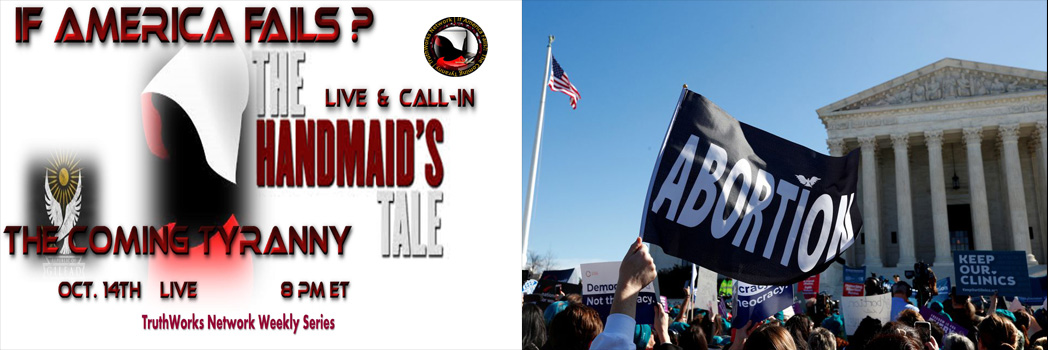
The anti-abortion law in Texas is just the latest example of our fading democracy. Janice Graham and L. Michelle Odom are launching “If America Fails?: The Coming Tyranny,” with a sneak-peek of the new 2022 series on October 14th at 8 pm ET. Mark your calendars now, stay tuned for the details, and plan on riding with us as we explore, with subject matter experts, the very troubling events going on in the country today. And oh yeah…for fans of “The Handmaid’s Tale,” Hulu series…we’re using the TV show as a foundation for exploring themes, from a Black perspective, related to fascism, white supremacy, religious cults, and more!
Fascism has found its ‘sweet spot’ and is unleashing itself in TEXAS! Their latest move, nearly outlawing abortion – SB8 – sets the stage for vigilantes around the country to hunt down the people who counsel, escort, drive, or in any way assist women in obtaining an abortion. This is serious, folks!
It’s serious because it is just one move of many showing us we are dealing with a group who don’t want to be bound by the U.S. Constitution…who are determined to remove, one-by-one, all the rights Americans have fought for and won in recent decades. It appears they want their own country – or to simply overtake this one.
What do we do while we watch democracy crumbling before our very eyes? Can we stop the tyranny eroding our cherished freedoms? Do we pretend we don’t see what we see? Do we worry ourselves about the women in Afghanistan, and pretend American women have any more certainty about the future?
Not at TruthWorks Network. Janice Graham and L. Michelle Odom are launching “If America Fails?: The Coming Tyranny,” with a sneak-peek of the new 2022 series on October 14th at 8 pm ET. Mark your calendars now, stay tuned for the details, and plan on riding with us as we explore, with subject matter experts, the very troubling events going on in the country today. And oh yeah…for fans of “The Handmaid’s Tale,” Hulu series…we’re using the TV show as a foundation for exploring themes, from a Black perspective, related to fascism, white supremacy, religious cults, and more!
Watching the Taliban gloating in the Presidential palace in Kabul this week after violently overthrowing the government there, gave me major January 6th déjà vu. The muscle memory of that day kicked in again: the disbelief and shock, the stark helplessness, the repeating question of how this could be happening.
This week, while the world looked on in horror at Afghanistan, marveling at the seemingly impossible speed and ferocity with which a group of extremists could overtake a foreign nation’s leadership and throw it all into chaos, the familiarity of the moment is something America needs to wrestle with. We cannot look away from the proximity of such a day here. We can’t ignore the repetition of history. We can’t pretend we weren’t on the brink of a nightmare.
America was (and in many ways still is) a hair’s breadth from living a very different story right now; from a radicalized minority of zealots having unchecked power and exposing us to a brutality that we would not recognize as our nation.
It would have taken very little:
A handful fewer courageous Capitol Police officers, a wrong turn or two in the crowded labyrinth beneath the halls of Congress, a couple of split-decisions by the insurrectionists or the Secret Service—and we’re living through what the people of Afghanistan are right now.
The story here wouldn’t have become an attempted coup, but a successful one. Donald Trump would have been installed as president, Republican politicians would have legislative carte blanche, and their armed, unhinged, sycophantic militia would be living out their racist, phobic fantasies with impunity.
This isn’t exaggeration or fear-peddling or sky-is-falling histrionics, it’s the sober admission that all that was planned by this grotesque movement could have so easily come to fruition. This was the intended goal. Overthrowing the Government and overturning the results of a free and fair election by force was the whole point of the insurrection—and simply relaxing because it was not successful is one of the greatest errors the good people of this nation could ever make. Afghanistan should make our blood boil and it should wake us up.
We’ve all seen the videos. We witnessed it with our own eyes. We watched how quickly the walls were scaled, how easily the doors were breached, how completely mob violence engulfs once rational people, how little is required to tip the scales of a Republic and bring it to its knees, how tenuous it all is. Our nation is not less vulnerable simply because we currently have a competent Administration, a compassionate adult president, and a ceremonial majority in Congress. While amoral, power-mad Trump acolytes like Lauren Boebert, Josh Hawley, and Marjorie Taylor Greene hold positions of power here, and while their conspiratorial, perpetually-oppressed rank-and-file are still perpetuating the big lie and willing to die for it, we remain in danger.
No one is saying these two events in themselves are on their face equal, but they are strikingly similar movements in different seasons of their evolution; built on the same theocratic fervor, the same glorification of violence, and the same cultic adoration of leadership. Americans should be horrified by the sickening display of religious extremists parading themselves through the halls of a Government they quickly overthrew, and we should be horrified at the unthinkable fear that drove people to grab onto departing planes and dying tumbling to the ground, and we should be deeply burdened to do all we can to help the good people there escape the monsters who now have the run of the house.
But we should do all of this while realizing how very fragile the place we call home currently is, how very close we were and still are to a lawless minority taking by force what they could not through fair elections and the democratic process.
The most reckless and dangerous thing we could do right now is to imagine that Afghanistan could not happen here. It nearly did.
The good people here need to work and fight and organize and vote to make certain that it does not happen again.
It’s a common mistake to think of Trump as a madman but Trump’s strongman tactics are more predictable than they seem. Political commentator and New York University professor Ruth Ben-Ghiat explains why.
She writes: “I’M NOT the one trying to undermine American democracy. I’m the one who’s trying to save it,” Donald Trump told the North Carolina Republican convention on June 5th. The former president boasts that he will be reinstated in August. Yet far from being dismissed as delusional, he enjoys solid support from millions of Republican voters, who regard him as the rightful president.”
Ruth Ben-Ghiat is a historian, educator, and commentator on fascism, authoritarian leaders, and propaganda — and the threats these present to democracies around the world. Professor of History and Italian Studies at New York University, she is author or editor of seven books and writes frequently for CNN and other media outlets. Her newest book is Strongmen: From Mussolini to the Present (Norton, 2020), which examines the authoritarian playbook illiberal leaders have used for a century.
The United States is not a failed state — just ask any American capitalist. But we desperately need something better for everyone else.
In an interview with Salon, economist Richard D. Wolff compared America to “a patient who has had a really bad cancer or a heart attack, and is now kept alive with tubes and chemicals and all the rest of it. He is not dead, but is in deep trouble.”
The United States is not a failed state — just ask any American capitalist. But we desperately need something better for everyone else.
American Capitalism Is Working — That’s the Problem
Tom Engelhardt even suggested in the Nation that we might need a new term for the contradiction that is America. The United States may be rich and powerful, he argued, but it “is also afloat in a sea of autocratic, climate-changing, economic, military, and police carnage that should qualify it as distinctly third world as well.” Perhaps “fourth world,” to capture the fact that we are “potentially the most powerful, wealthiest failed state on the planet.”
It certainly feels like we’re failing. What kind of state deploys the National Guard to menace peaceful protesters while elderly people are being decimated by COVID-19 and forest fires are raging? What kind of state forces its nurses and doctors to work without proper protective equipment? Or allows its people to go hungry and get evicted, while handing out trillions to the wealthiest few amid a nationwide crisis?
Americans are right to be furious at the Trump administration’s ineptitude and willingness to dump the costs of the coronavirus pandemic onto working people. But despite its obvious failures, the United States is not a failed state — and why this distinction matters goes beyond semantics. Diagnosis shapes response. If we’re going to get ourselves out of this mess, we need a clearer picture of what is broken and how to begin fixing it.
It’s time to be blunt.1 The right-wing political alliance anchored by the Republican party and Trumpism coheres around a single concrete objective—taking absolute power in the U.S. as soon and as definitively as possible. And they’re more than ready, even seemingly want, to destroy the social fabric of the country to do so.
They smell blood in the water. They have a strong majority on the Supreme Court and a majority in the federal judiciary overall. Republicans imagine that with the aid of the aggressive campaign of disfranchisement they’re pursuing in forty-three states, they’ll take control of one or both houses of Congress next year. Mitch McConnell devised the playbook against the Obama presidency; with a Democrat in the White House, the GOP’s sole legislative agenda is obstruction, to make certain that no legislation passes, that no appointments are confirmed, to the extent of often enough forcing government shutdowns. Corporate media, punditry, and academics have obscured this Republican strategy with names implying a tit-for-tat perspective, like “partisan gridlock,”2 which, they lament, is causing Americans to lose patience with and trust in government.
“A new book helps us make sense of this. Called “The End of the End of History,” it projects the future of global politics at a moment when Western liberal democracy’s future no longer seems assured, as the allusion to Francis Fukuyama’s famous (and misrepresented) thesis suggests.
This sort of increasingly virulent reactionary politics forms one of the “ideologies of the future,” imagined by co-authors Alex Hochuli, George Hoare and Philip Cunliffe. They posit a future authoritarian populism fusing a longing for “strongman” leaders with a “Malthusian narrative.”
This narrative sees pressing global challenges as an opening to build up a zero-sum ideology that emphasizes “limited resources” and a “need to reduce surplus populations” by “removing outsiders and other elements” that corrupt the “indigenous” population, as the Real Answer to those challenges.
What’s relevant for us here is the book’s argument that covid has provided this form of politics with a new reason for being, a moment it will seize by telling a “nationalist” story of the global pandemic: A nationalist interpretation would see a forceful rejection of globalization and cosmopolitanism: the organic body of the indigenous nation is threatened by deleterious outside influences, and limits on resources necessitate their exclusion.
I think something like this may be developing in the U.S. right now. There’s a peculiarly ominous signal in the way GOP governors such as Greg Abbott of Texas and Ron DeSantis of Florida are fusing their rejection of collective public health solutions with demagoguery about migrants.”
A historian of fascism and political atrocity on Trump, the mob and what comes next.
. . .Post-truth is pre-fascism, and Trump has been our post-truth president. When we give up on truth, we concede power to those with the wealth and charisma to create spectacle in its place. Without agreement about some basic facts, citizens cannot form the civil society that would allow them to defend themselves. If we lose the institutions that produce facts that are pertinent to us, then we tend to wallow in attractive abstractions and fictions. Truth defends itself particularly poorly when there is not very much of it around, and the era of Trump — like the era of Vladimir Putin in Russia — is one of the decline of local news. Social media is no substitute: It supercharges the mental habits by which we seek emotional stimulation and comfort, which means losing the distinction between what feels true and what actually is true.
Post-truth wears away the rule of law and invites a regime of myth. These last four years, scholars have discussed the legitimacy and value of invoking fascism in reference to Trumpian propaganda. One comfortable position has been to label any such effort as a direct comparison and then to treat such comparisons as taboo. More productively, the philosopher Jason Stanley has treated fascism as a phenomenon, as a series of patterns that can be observed not only in interwar Europe but beyond it. . . .






 If America Fails?